
- within Law Department Performance and Accounting and Audit topic(s)
Duane Morris Takeaway: The gargantuan settlement numbers and high rates of certification have continued to fuel growth in class action filings by the plaintiffs' class action bar. In 2025, large settlements continued to attract skilled attorneys to the plaintiffs' side and continued to incentivize plaintiffs' attorneys to file more and more lawsuits on a class basis.
Watch the video below to see Class Action Review Editor Jerry Maatman discuss this trend:
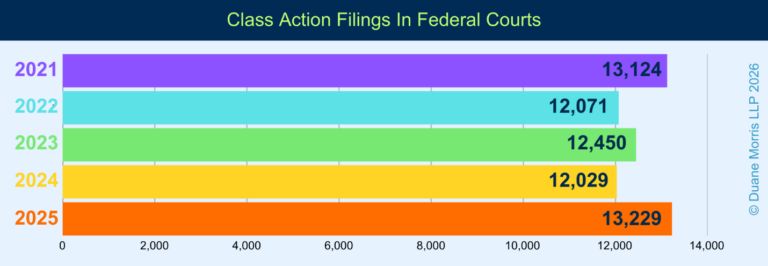
The number filed in 2025 represents a 9% increase over the number of class actions filed in federal court in 2022 and 2024.
In 2025, the number of class action lawsuits filed in federal courts across the country exceeded 13,229, which equates to more than 52 class actions filed per day on each of the 250 court days in 2025.
That number represents an increase from 2024 and reflects a growth trend relative to the number of class action filed over the past four years.
Indeed, the number of class action lawsuits filed in 2022 in federal courts totaled 12,071, the number of class actions filed in 2023 totaled 12,450, and the number of class actions filed in federal courts in 2024 totaled 12,029.
Class action filings over the same period likewise shifted toward perceived plaintiff-friendly jurisdictions.
From 2022 to 2025, class action filings in federal courts across the country grew unevenly across the federal circuits, as reflected in the following graph.

In terms of the most growth, from 2022 to 2025, class action filings grew by more than 50% in four federal Circuits – the First, Fourth, Seventh, and Ninth. In the First Circuit, in 2022, plaintiffs filed 202 class actions and, in 2025, filed more than 303 class actions, an increase of 50%.
In the Fourth Circuit, in 2022, plaintiffs filed 471 class actions, and, in 2025, plaintiffs filed more than 732 class actions, an increase of 55%. In the Seventh Circuit, in 2022, plaintiffs filed 948 class actions, and, in 2025, they filed 1,423 class actions, an increase of 50%.
In the Ninth Circuit, in 2022, plaintiffs filed 2,276 class actions and, in 2025, plaintiffs filed 3,791 class actions, an increase of 67%.
In 2025, those four Circuits likewise had higher percentages of judicial seats appointed by Democratic presidents than Republican presidents. In the First Circuit, there were 29 district court seats within the First Circuit in 2025, and six or 23% were held by judges nominated by Republican presidents, and 20 or 77% were held by judges nominated by Democratic presidents, with three vacancies.
In the Fourth Circuit, there were 56 district court seats in 2025, and 22 or 43% were held by judges nominated by Republican presidents, and 29 or 57% were held by judges nominated by Democratic presidents, with five vacancies. Four of the five vacancies (all in North Carolina) were filled by Republican nominees on December 2, 3, and 4, 2025.
In the Seventh Circuit, there were 48 district court seats in 2025, and 17 or 36% were held by judges nominated by Republican presidents, and 30 or 64% were held by judges nominated by Democratic presidents, with one vacancy.
In the Ninth Circuit, there were 110 district court seats in 2025, and 21 or 20% were held by judges nominated by Republican presidents, and 86 or 80% were held by judges nominated by Democratic presidents, with three vacancies.
The appellate courts in those three of those four federal Circuits reflected similar imbalances. In 2025, there were six appellate court seats on the First Circuit, and one or 17% was held by a Republican-nominated judge, and five or 83% were held by Democratic-nominated judges.
In 2025, there were 15 appellate court seats on the Fourth Circuit, and 6 or 40% were held by Republican nominees, and 9 or 60% were held by Democratic nominees. In 2025, there were 29 appellate court seats on the Ninth Circuit, and 13 or 45% were held by Republican-nominated judges, and 16 or 55% were held by Democratic-nominated judges.
With respect to the Seventh Circuit, while the number of Democratic nominees does not yet exceed the number of Republican nominees, the proportion has shifted over the past four years. In 2021, eight of the 10 judges were nominated by Republican presidents and two by Democratic presidents with one vacancy. By 2025, only six of the 10 judges were nominated by Republican presidents, and five of the 10 judges were Democratic nominees.
Myriad factors are contributing to the increase in class action filings. No one factor is the key driver; instead, the legal landscape manifests various causes that contribute to the surge of lawsuits.
These factors include: (i) changes in laws and regulations that make it easier to bring suits, or adoption of new statutes affording expanded causes of action; (ii) evolving judicial interpretations of Rule 23 that facilitate class certification; (iii) increased awareness of rights and corporate accountability by workers, consumers, and the public; (iii) social inflation pressures that fuel great jury awards and higher settlements; (iv) outside investors financing lawsuits; (v) more complex business operations and data-drive technologies, including artificial intelligence; and (vi) activist organizations and government enforcement litigators pushing the boundaries of causes or action and recoveries for alleged corporate wrongdoing.
Implications: In sum, class action filings in 2025 grew to new heights. The highest growth rates occurred in federal Circuits with high percentages of Democratic-appointed district court judges, suggesting that plaintiffs are filing more class actions in jurisdictions where they anticipate more favorable case law precedent and a higher chance of a more plaintiff-friendly judicial assignments.
Disclaimer: This Alert has been prepared and published for informational purposes only and is not offered, nor should be construed, as legal advice. For more information, please see the firm's full disclaimer.
[View Source]