

If arbitration filing statistics tell us anything, it’s where business activity and business disputes are headed. Recent filing trends at some of the world’s leading arbitral institutions show that international arbitration remains strong, even several years after the disruptions caused by COVID-19.
The latest numbers show that institutions in Asia continue to gain ground, reflecting broader shifts in global trade, investment, and cross-border business activity.
2025 Case Filings at Seven International Arbitral Institutions Reflect Growth
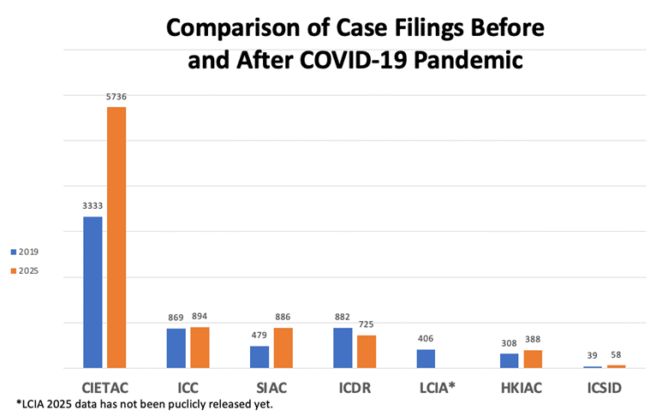
During the pandemic, many expected international dispute activity to slow significantly. Arbitration filings have generally remained steady and, in many cases, continued to increase.
This pattern is reflected in the below chart:
Sources
CIETAC – http://www.cietac.org/index.php?m=Page&a=index&id=40&l=en
ICC – https://iccwbo.org/media-wall/news-speeches/icc-unveils-preliminary-dispute-resolution-figures-for-2021/
SIAC – https://www.siac.org.sg/newsite/index.php/70-articles-publication/190-annual-report
ICDR – https://www.adr.org/research
LCIA – https://www.lcia.org/lcia/reports.aspx
HKIAC – https://www.hkiac.org/about-us/statistics
ICSID – https://icsid.worldbank.org/resources/publications/icsid-caseload-statistics
The last several years have brought supply chain disruptions, inflation, geopolitical tensions, shifting regulatory requirements, and changing trade relationships. Those developments have created plenty of opportunities for commercial disputes.
For companies operating internationally, arbitration continues to offer many of the advantages it always has: neutrality, confidentiality, and the ability to enforce awards across jurisdictions.
CIETAC Continues to Lead the Pack
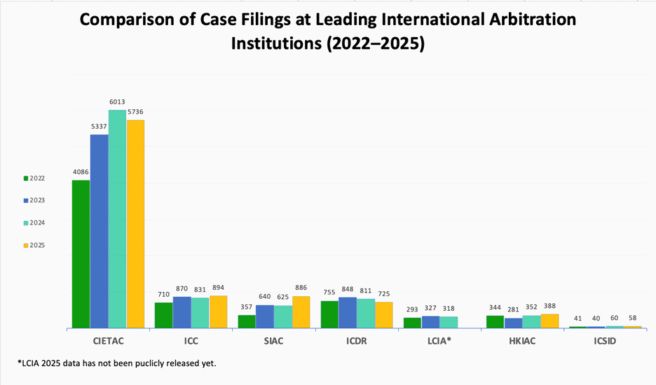
CIETAC’s filing numbers stand out. Its caseload now significantly exceeds that of the other major institutions included in the comparison and continues a trend that has been developing for several years.
China remains one of the world’s most important commercial markets, and companies doing business there are increasingly negotiating contractual provisions that call for disputes to be resolved through Chinese arbitral institutions.
For in-house counsel, that means CIETAC is increasingly a negotiated option. Even companies that have historically defaulted to ICC, LCIA, or ICDR clauses may find themselves agreeing to dissolve disputes through CIETAC.
Sources
CIETAC – http://www.cietac.org/index.php?m=Page&a=index&id=40&l=en
ICC – https://iccwbo.org/media-wall/news-speeches/icc-unveils-preliminary-dispute-resolution-figures-for-2021/
SIAC – https://www.siac.org.sg/newsite/index.php/70-articles-publication/190-annual-report
ICDR – https://www.adr.org/research
HKIAC – https://www.hkiac.org/about-us/statistics
ICSID – https://icsid.worldbank.org/resources/publications/icsid-caseload-statistics
Singapore’s Rise Continues
SIAC’s continued growth reflects its established role as a leading center for international dispute resolution.Strong judicial support, a business-friendly environment, and a reputation for efficiency have made it an increasingly attractive option for parties negotiating cross-border agreements.
Today, Singapore is no longer simply an alternative to London, Paris, or New York. In many transactions, it is one of the first venues being considered. That trend appears likely to continue as investment and trade throughout Asia remain strong.
The Traditional Players Aren’t Going Anywhere
None of this means that institutions such as the ICC, ICDR, LCIA, HKIAC, or ICSID are losing relevance.
Each continues to administer substantial caseloads and remains a trusted forum for resolving international disputes.
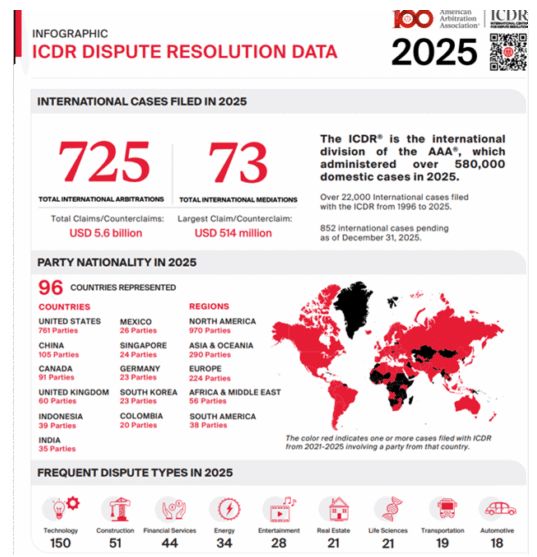
The ICDR’s 2025 statistics provide a useful reminder that North America remains a significant center for international dispute resolution. The institution reported 725 international arbitrations involving parties from 96 countries, with claims exceeding $5.6 billion.
Technology, construction, financial services, and energy disputes continue to feature prominently, reflecting the significant cross-border investment and commercial activity occurring in these sectors. For in-house counsel, these figures underscore that arbitration remains relevant across a wide range of industries not just traditional infrastructure projects.
As a result, the choice of arbitral institution has become increasingly strategic. Companies are paying closer attention to factors such as location, procedural efficiency, costs, industry expertise, as well as the enforceability concerns when deciding where disputes should be heard.
Looking Beyond the Numbers
The filing statistics also provide insight into broader business trends. The strongest growth is occurring in Asia. Not coincidentally, that is where many companies are expanding operations, investing capital, building supply chains, and forming new commercial relationships. Disputes tend to follow business activity. Arbitration filings often do too.
While much of the recent growth has occurred in Asia, cross-border business activity continues to expand throughout Latin America and the Caribbean as well. Miami has increasingly emerged as a gateway for companies operating across markets and a growing center for international dispute resolution.
U.S. Cities Continue to Grow as International Arbitration Venues
Cross-border business activity continues to expand throughout Latin America and the Caribbean as well. Miami has increasingly emerged as an important gateway for companies operating across these markets and remains a significant center for international dispute resolution. New York and Miami dominate the U.S. landscape for international arbitration. Miami has emerged as the second most active U.S. seat for international arbitration and the leading U.S. venue for disputes involving Latin America and the Caribbean. The ICDR’s published data shows Miami ranked second among all U.S. cities for international case filings.
Seyfarth’s recent expansion into Miami reflects the city’s growing role in international arbitration and cross-border business disputes. For companies with contracts in Brazil, Chile, Mexico, and elsewhere in Latin America, Miami increasingly offers the combination of legal infrastructure and geographic convenience. The firm’s Miami office, together with its Latin America practice, further enhances its ability to support clients involved in construction and infrastructure disputes throughout Latin America and the Caribbean.
The content of this article is intended to provide a general guide to the subject matter. Specialist advice should be sought about your specific circumstances.
[View Source]