

- within Corporate/Commercial Law topic(s)
- in India
India's journey with Geographical Indications (GI) started 10 years back in 2003, when the GI Act and Rules came into force. In order to comply with India's obligations under the TRIPS agreement, India enacted the Geographical Indication of Goods (Registration and Protection) Act, 1999 which came into force with effect from September 15, 2003.
Geographical indications identify a good as originating in a particular territory or a region or locality, where a given quality or reputation or other characteristic of the good is essentially attributable to its geographical origin. Any association of persons or producers or any organization or authority established under the law to represent the interest of the producers of the concerned goods can apply for registration of GI. There are 34 different classes of goods, on the basis of which an application for registration of a GI can be filed. In addition, the same can also be filed claiming priority from a convention country application. A registration is valid for a period of ten years and the same can be renewed thereafter. By registering an indication in India a right holder can prevent its unauthorized use by others and also promote economic prosperity of the producers of the said good in a particular region. An unregistered GI can be enforced by initiating an action for passing off. India's GI Registry is situated in Chennai and like the other intellectual property rights, GIs also come under the purview of the Controller General of Patents, Designs and Trademarks.
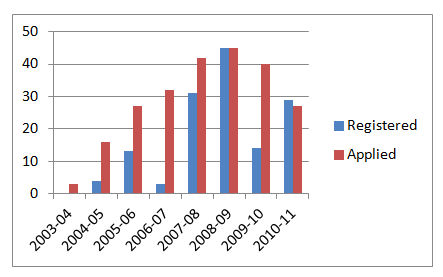
Since 2003, with the first application for registration of 'Darjeeling Tea' the filing has reflected an escalating trend. In the year 2004-2005 only 4 registrations were granted whereas in the year 2012-13 a total of 21 goods were granted GI status. The year 2008-09 witnessed a huge hike in the number of applications filed for GI registration as can be seen from the graph. However this reduced in the following year and then the trend was stabilized during the following years.
For the first time a GI 'authorized user' application, was filed in the year 2009-10. As on March 31, 2013, a total number of 193 GIs stand registered in India with Banaras Brocades and Sarees (Logo) being the latest.
An interesting trend that can be noticed is the state of origin of various registrations. The southern States in India have topped the charts in obtaining GI registrations as against the rest of the States. As on March 31, 2013, the state of Karnataka is leading the way with 32 GI registrations followed by the state of Tamil Nadu with a total number of 24 registrations. Andhra Pradesh (22) and Kerala (20) are also not far behind, falling in the third and the fourth position respectively. These four states together account for over 50 % of the total GI registrations granted in India. Comparatively, applications/registrations originating from foreign jurisdictions such as France, Peru, Portugal, UK, USA, Italy and Mexico are much lesser in number.
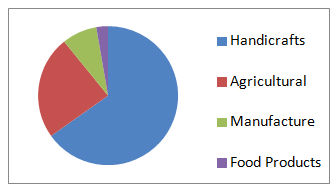
Another interesting trend to be looked at is the type/nature of goods that are being registered. An examination of this trend reflects that the number of registrations for Handicrafts is leading followed by 'agricultural' goods and 'manufactured' goods. The pie diagram shows the ratio of goods with respect to the field of industry.
This increased awareness and movement ahead is not merely restricted to obtaining registration of GIs but also extends towards maintaining and defending protection for GIs. A number of Rectification applications were filed for removal of GI status granted to goods. The most talked about ones are the rectification filed against 'Darjeeling tea' and 'Thirupathi Laddo'. Both the rectification applications were dismissed and the Registrar's decision to grant GI status was held valid. Recently another interesting dispute arose, whereby an appeal was filed before the Intellectual Property Appellate Board (IPAB) against the Registrar's decision to grant GI status to Payyannur Pavitra Ring on the application filed by Payyanur Pavitra Ring Artisans. The said appeal filed against the decision on opposition proceedings, was moved by M/s Subhash Jewellery. While deciding the matter (Order here), IPAB analysed the meaning and ambit of Section 11 of the GI Act which deals with 'who can apply for registration'. While removing the name of Payyanur Pavitra Ring Artisans from the Register, the IPAB remanded the matter back to Registry for consideration. In the said order the interest of the persons concerned were taken care of and Appellate Board observed that the Act is still in its incipient stage and the group targeted may not be adequately equipped to protect their own interest.
Even though 10 years is not a long time period, the regime of GIs may still be considered to be in its initial stages, awareness and the need for protection under the GI Act in India has increased tremendously during the period. In a fast growing economy like India, the need for protecting the goods originated from a particular region or locality is significant - be it Darjeeling tea, Madhubani Paintings, Chanderi Fabric, Madhurai Malli, Aranmula Kannadi, Kancheepuram silk- the role that these play in the Indian tradition, make its protection quintessential to preserving the cultural heritage of the nation.
* Data and statistics used in this article are referred from the Annual Report(s) of the Indian IP Office and the GI Registry website at http://ipindia.nic.in/girindia/
The content of this article is intended to provide a general guide to the subject matter. Specialist advice should be sought about your specific circumstances.
