A reform of the Luxembourg pensions regime came into force on 1 January 2026, introducing a range of measures designed to make the regime sustainable and offer more flexibility to insured individuals.
On 18 December 2025, Luxembourg adopted a significant reform of its pensions regime as Parliament voted through bills of law 8634 and 8640. The two laws of 19 December 2025 were published on 19 and 22 December 2025 respectively.1
The key measures introduced by the reform are as follows:
- Extension of working career: starting from 1 January 2026, the 480-month period of mandatory insurance will be gradually increased by up to eight full months of effective contributions, according to the timetable below.
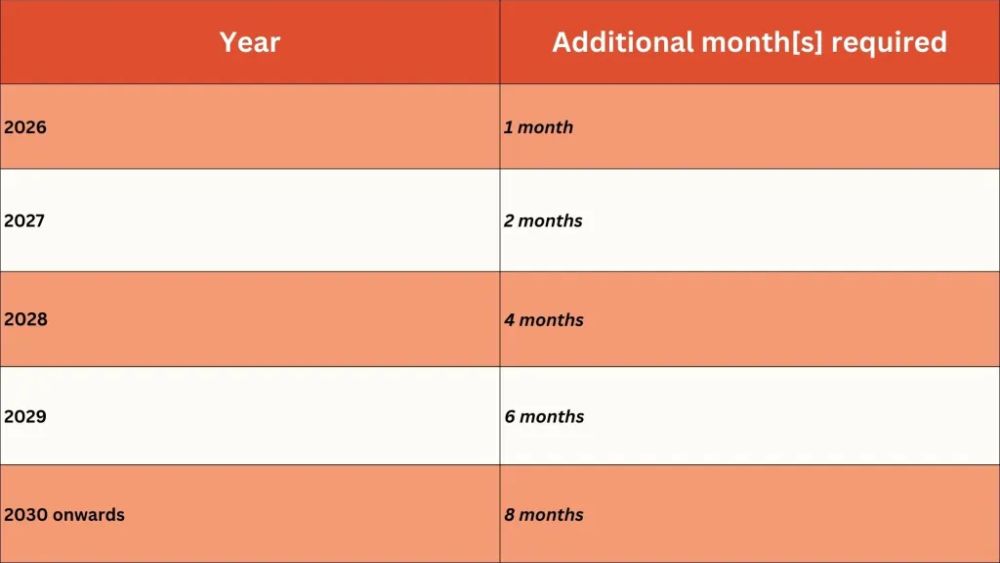
Exceptions: the extension does not apply to pension entitlement following a period of receipt of the early retirement allowance (indemnisation en préretraite) for employees who work shifts or nights or the early retirement allowance due to company restructuring (préretraite-ajustement).
The option to take the pension early from the age of 57 with 480 months of effective contributions remains in place and the phased extension does not apply in this situation.
- Increase of contribution rate: the overall contribution rate increased from 24% to 25.5% with effect from 1 January 2026. This increase applies for 2026 to 2032.
- Flexibility for periods of study: from now on, up to nine years of post-18 study or professional training (not under a paid apprenticeship) may count towards the pension insurance career.
This is a major change — previously, the study period was limited to the ages of 18 to 27. It has now become more flexible and can be spread throughout an individual's working career, allowing the pensions regime to adapt better to the realities of modern life and professional training, particularly returning to education as an adult.
- Phased pension — a new way to transition into
retirement: employees who satisfy certain conditions
are able to receive a phased pension (pension progressive)
that enables them to reduce their working hours gradually while
receiving a compensating allowance.
- Eligibility conditions: the employee must (1) satisfy the conditions for entitlement to an early old-age pension, (2) work in a role of at least 75% of the full-time equivalent for a minimum of three years before making the request to reduce their working hours, and (3) obtain their employer's agreement to a reduction in their working hours. The employee must notify the request to their employer at least four months before the desired start date. The employer has one month to respond.
- Implementation: the employee's working time must be reduced by a minimum of 25% of their initial working time and their remaining working time must be at least 16 hours per week. The reduction in working time has to take effect on the first day of the month and the staff delegation must be informed.
- Allowance: an employee on a phased pension is entitled to a monthly allowance paid by their employer with their salary. This allowance equals the amount of pension to which the employee would have been entitled, applying the specified reduction rate. The National Pension Insurance Fund (Caisse nationale d'assurance pension) will reimburse the employer on a monthly basis for all costs, including the employer's share of social security contributions. If the employee's employment is terminated in a collective redundancy, on grounds not inherent to them as an individual or by operation of law, the National Pension Insurance Fund must pay the phased pension allowance directly.
- End of right to allowance: the right to the allowance ceases, among others, when the employee turns 65, dies, requests a disability or early old-age pension, works for longer than the agreed working time or carries on another activity that earns more than half the monthly minimum social wage.
These measures entered into force on 1 January 2026, other than the phased extension of contribution periods, which enters into force on 1 July 2026.
- New tax measures: two new tax provisions have
been introduced to incentivise workers to remain professionally
active until the legal retirement age and encourage them to
subscribe to a private pension plan (contrat de
prévoyance vieillesse) as early as possible:
- Tax allowance: a continuation of working life tax allowance of EUR 9,000 per year (capped at EUR 750 per month) is granted to any taxpayer who satisfies the conditions for receiving a personal pension but opts to defer their request.
- Increase of maximum deduction for payments into a private pension plan: the ceiling on the tax deduction for payments into a private pension plan is increased from EUR 3,200 to EUR 4,500 per taxpayer.
The tax measures enter into force from the 2026 tax year.
- Early old-age pension: the law of 19 December 20252 corrects an inequality of treatment. Previously, recipients of an early old-age pension who carried on an unsalaried activity risked losing their pension if their income exceeded a certain threshold, with no possibility of partial reduction. By contrast, recipients of an early old-age pension who carried on a salaried activity were able to benefit from a reduction of their pension, rather than losing it entirely. On 1 March 2024, the Constitutional Court held that this difference is unconstitutional.3 The new law puts an end to this inequality. It came into force retroactively on 9 March 2024, the date on which the judgment of the Constitutional Court was published in the Luxembourg Official Journal.
Finally, pensions increased by 1.5% on 1 January 2026.
The content of this article is intended to provide a general guide to the subject matter. Specialist advice should be sought about your specific circumstances.
[View Source]