

At a glance
We are pleased to present an overview of the key trends and noticeable events that shaped the Dutch public M&A market from January 1, 2025 to June 26, 2026.
Outlook
We are cautiously optimistic in our outlook for public M&A in 2026. At the time of writing this outlook, ongoing geopolitical and macroeconomic uncertainty seems to be a certainty. This clouds visibility on key dealmaking parameters such as future GDP growth, the regulatory landscape, inflation, interest rates and availability of financing.
At the same time, transformational forces such as AI and the energy transition continue to redefine industries. Depending on the sector and the geographic location of a business, the (cumulative) effects of all the aforementioned can be very different, explaining sectoral and geographic differences.
We expect executives will continue to pursue bold moves, as corporates increasingly look to secure critical capabilities, achieve scale and strengthen long-term competitiveness through large-scale strategic transactions. We also anticipate selective activity from private equity sponsors where they can bring genuine added value to the target business. Taken together, these drivers give us reason to believe that Dutch public M&A will see meaningful activity in 2026.
Looking back at the last five years: key stats
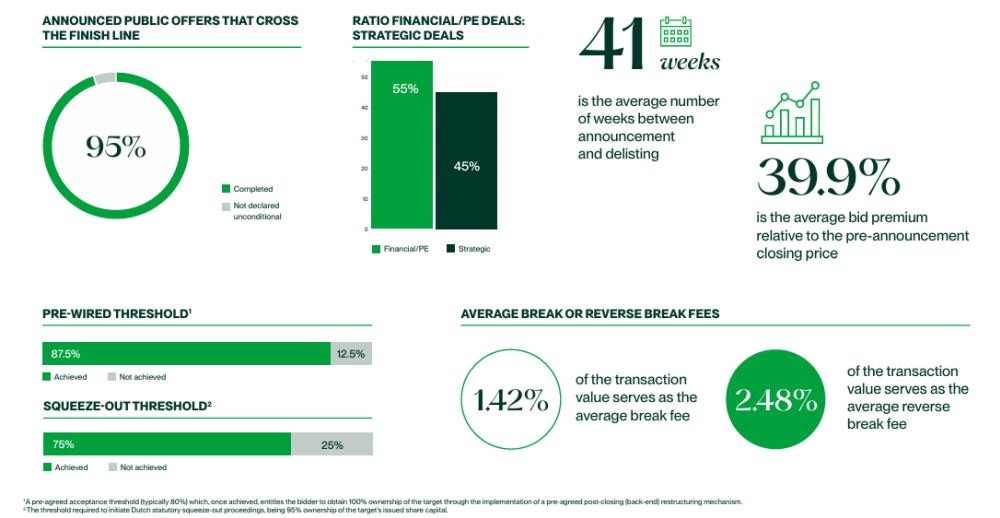
Key trends
1. A TURBULENT YEAR WITH HIGH DEAL VOLUME AND BIG-TICKET CROSS-BORDER TRANSACTIONS
- Amid a series of significant developments—from Liberation Day tariff announcements to periodic U.S. government funding standoffs and broader geopolitical volatility—2025 proved turbulent but remarkably more active than 2024.3
- Whereas 2024 saw only three smaller ticket transactions (offers for Allego, Hydratec and PB Holding), 2025 was characterised by a strong increase in big-ticket (cross-border) transactions accounting for almost EUR35 billion in Dutch public M&A volume.
2. STRATEGIC M&A TAKES CENTRE STAGE; PE LARGELY REMAINS ON THE SIDELINE
- Looking at the deals involving Dutch targets listed on Euronext Amsterdam and listed in the U.S., all deals in 2025 were between strategic players, evidencing that strategic bidders are active and see M&A as a key lever for growth and business transformation. The acquisition of Just Eat Takeaway by Prosus, Iveco Group by Tata Motors, JDE Peet’s by Keurig Dr Pepper, Merus by Genmab and the all-stock merger of equals between AkzoNobel and Axalta exemplify this trend, with strategic parties seeking to reposition themselves, access new markets, or accelerate transformative growth through targeted transactions.
- Despite the offer for InPost led by Advent and FedEx, involvement from private equity firms remained largely absent from Dutch public M&A. This raises the question whether 2026 will mark a resurgence of private equity in Dutch public M&A.
- Last year’s mid- and small-cap delisting trend did not carry into 2025: only Sarabel pursued a full take-private of B&S Group, while Value8’s mandatory offer (which are rare) for Ctac was not aimed at pursuing majority control or a delisting.
3. DEAL ACTIVITY DUTCH BIOTECH COMPANIES LISTED IN U.S.
- In 2025, we saw four take-privates of Dutch entities listed in the U.S. Three of those took place in the biotech and pharmaceutical sector: the acquisitions of Merus by Genmab, CureVac by BioNTech and LAVA by XOMA Royalty. The fourth was the acquisition of Playa Hotels and Resorts by its larger competitor Hyatt.
- All four transactions showcase clear strategic drivers based on each bidder’s fit for the target’s next phase. All transactions took place after an initial outreach by the target company. In most cases, the target boards had previously conducted, or were simultaneously conducting, an extensive strategic review during which various strategic options were considered. These options included seeking potential bidders, pursuing new collaborations, in-licensing new products for development, or exploring liquidation or break-up scenarios.
4. BACK-END STRUCTURES: ESTABLISHED IN THE NETHERLANDS AND EXPORTED ABROAD
- So-called “pre-wired back-end structures”4 remain a firmly established feature of the Dutch public M&A market to obtain full ownership, including offers for Dutch targets listed in the U.S., with Merus/Genmab and CureVac/BioNTech serving as notable examples.
- In the U.S. nexus transactions described above, the pre-wired back-end structure is always implemented directly after the subsequent offering period, enabling the bidder to acquire full ownership and control within days after settlement without having to go through lengthy statutory proceedings to squeeze out remaining minority shareholders.
- The pre-wired asset sale structure has also been “exported” to other (non-U.S.) cross-border transactions, such as the offers for B&S by Sarabel (2025) and InPost by Advent (2026), both involving Luxembourg target entities listed on Euronext Amsterdam, whereby the parties agreed that the bidder has the right to implement a pre-wired asset sale structure. Additionally, in the offer for B&S, Sarabel even reserved the right to implement the pre-wired asset sale structure in a ≥95% scenario, preferring it over the “royal” statutory squeeze-out route.
- It has become increasingly common for parties to agree on a pre-wired structure that may be implemented prior to the commencement of squeeze-out proceedings.Such structures were a feature of the offers for Intertrust, Ordina, Beter Bed, Just Eat Takeaway, and JDE Peet’s. This allows bidders to obtain full control pending lengthy squeeze-out proceedings, thereby accelerating the timeline to integrate the target within the bidder’s group.
To read this article in full, please click here.
The content of this article is intended to provide a general guide to the subject matter. Specialist advice should be sought about your specific circumstances.
[View Source]


