Sophie Grace is a leading Australian firm specialising in both compliance and legal services to participants within the financial services and credit industries. We have serviced Australian and international clients across the financial sector for over a decade. From obtaining the required licences to operate your business to the provision of ongoing compliance support, many businesses have benefited from Sophie Grace’s extensive knowledge in the financial and credit space.
We take pride in our ability to offer tailored solutions to a broad range of businesses whilst keeping business practicalities and obligations to regulators at the forefront of our minds when delivering services and advice. Our consultancy services can equip you with assistance and clarity in your business endeavours.
The AML/CTF regime will be extended to a variety of Tranche 2
services from July 2026 onwards. For professionals such as
accountants, lawyers, estate agents and dealers in precious stones,
this will be a major change to their compliance framework. But what
about existing reporting entities?
The AML/CTF regime currently regulates a wide range of financial
services business, including financial service providers, banks,
remittance service providers and digital currency exchange
providers. These entities may also provide Tranche 2 services as
part of their broader business.
What should existing reporting entities do?
In their preparation for the reforms, existing reporting
entities should already be considering their AML/CTF policies and
procedures. In addition to this, existing reporting entities should
review section 6 of the amended AML/CTF Act, specifically Table 6
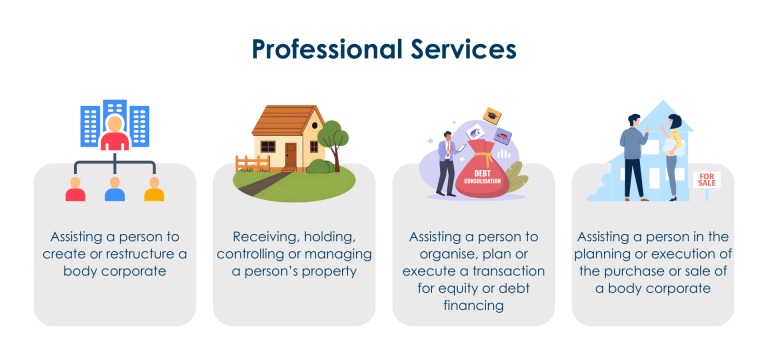
which lists the professional services which will be captured by the
regime from 1 July 2026 onwards.
Existing reporting entities should map all services against the
designated services listed in section 6 and determine if they also
provide Tranche 2 services. Existing reporting entities should then
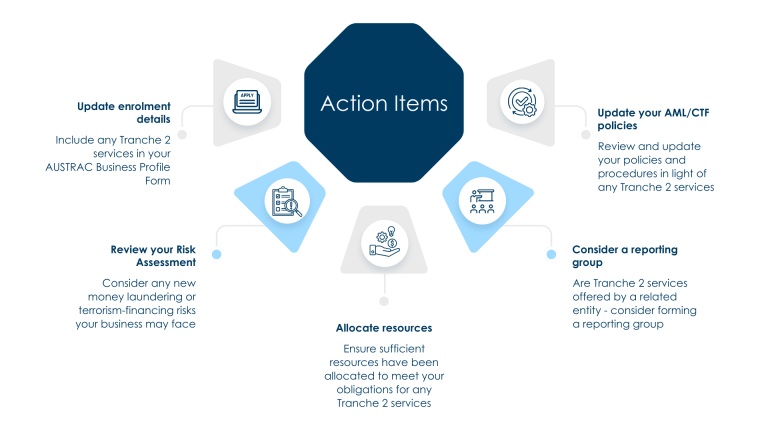
take action to:
update AUSTRAC enrolment or registration details;
review and update the money laundering or terrorism financing
risk assessment to include any new risks the business faces;
review the customer base of the business for any changes;
allocate additional resources to ensure the business is meeting
AML/CTF obligations for newly captured Tranche 2 services;
determine whether a reporting group needs to be formed to
include additional group entities; and
review and amend AML/CTF policies and procedures in light of
the Tranche 2 services.
AUSTRAC's guidance in relation to some of the Tranche 2
professional services in Table 6 of section 6 of the AML/CTF Act
which may apply to existing reporting entities is summarised
below.
Designated Service
Important Guidance
Examples
Assisting a person to plan or execute; or
otherwise acting on behalf of a person
in,
the creation or restructuring of a body corporate or other
legal arrangement.
Body corporate includes:
companies;
incorporated associations;
incorporated limited partnerships; and
corporations sole.
Other legal arrangement includes:
express trusts
general partnerships;
joint ventures;
unincorporated associations; and
foreign equivalents.
hanging the legal form of a company (including via a
merger)
drafting, reviewing and negotiating corporate agreements and
business documents (such as a constitution, partnership or
shareholder agreements;
drafting and reviewing trust deeds and documents;
drafting, reviewing and negotiating documents to support a
customer's mergers
registering applications with ASIC;
lodging forms with ASIC;
conducting due diligence on accounts and finances for corporate
transactions
Assisting a person in organising, planning or executing
a transaction; or
otherwise acting on behalf of a person in a
transaction,
for equity or debt financing relating to a body corporate
or other legal arrangement.
Equity or debt financing includes all capital and debt raising
methods
The provision of general advice about equity or debt financing is
not captured as a designated service as it doesn't directly
assist in organising, planning or executing a specific financing
transaction.
Equity capital raising, such as initial public offerings,
venture capital and share purchase plans; and
debt financing, such as secured or unsecured bonds, bills or
notes, asset financing, loans (including government loans) and
debentures.
Receiving, holding, controlling or managing a
person's property as part of a transaction; or
Otherwise acting on behalf of a person in relation to a
transaction.
Property includes a persons:
money;
accounts;
securities and securities accounts;
virtual assets
This designated service isn't limited to transactions relating
to real estate or bodies corporate.
Managing sale proceeds or purchase funds for a customer on
escrow (sometimes referred to as 'transit money');
having authority over a customer's account and makes
payments from that account on behalf of a customer. For example, to
make loan repayments to a financial institution relating to a
transaction; and
helping create legal arrangements to disburse client funds to
help purchase an asset on their behalf.
Assisting a person in the planning or execution of a
transaction; or
otherwise acting for or on behalf of a person in a
transaction,
to sell, buy or otherwise transfer a body corporate or
legal arrangement.
Body corporate includes:
companies;
incorporated associations;
incorporated limited partnerships; and
corporations sole.
Other legal arrangement includes:
express trusts;
general partnerships;
joint ventures;
unincorporated associations; and
foreign equivalents.
representing the customer in negotiations for the sale;
preparing or reviewing contracts for sale
conducting due diligence, valuation of assets and liabilities
in anticipation for the sale;
obtaining Foreign Investment Review Board approvals, and
Australian Securities Exchange and ASIC waivers for clients;
preparing for financial settlement; and
preparing documents to be provided to an authority (such as
ASIC) for the transfer of the body corporate.
The content of this article is intended to provide a general
guide to the subject matter. Specialist advice should be sought
about your specific circumstances.