

- within Government and Public Sector topic(s)
- with Inhouse Counsel
- in India
- with readers working within the Banking & Credit and Business & Consumer Services industries
AUSTRAC has released its Regulatory Priorities for 2025-26, outlining the focus areas which AUSTRAC will concentrate its regulatory efforts on over the next 12 months.
AUSTRAC's regulatory efforts are directed at two strategic objectives:
- Improving money laundering, terrorism financing and proliferation financing (ML/TF/PF) risk management through reporting entities implementing effective anti-money laundering and counter-terrorism financing (AML/CTF) controls; and
- Enabling AUSTRAC's intelligence function through high quality transaction reporting from reporting entities.
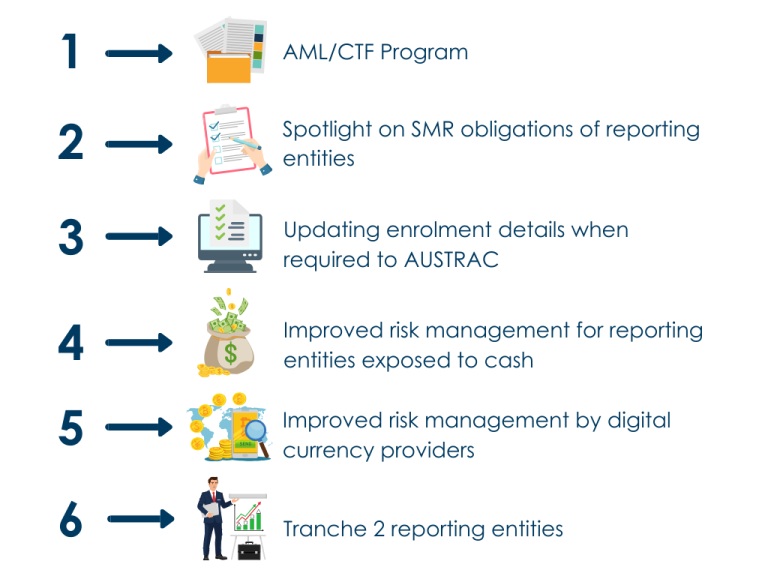
In 2025-26, AUSTRAC has 6 main areas of priority impacting reporting entities.
AML/CTF Programs
In light of the reforms to the existing AML/CTF Act and Rules, AUSTRAC is focussing on the AML/CTF programs of existing reporting entities. AUSTRAC expects existing reporting entities to:
- continue managing their existing ML/TF risks and implementing appropriate controls;
- develop an implementation plan in relation to adhering to the amended AML/CTF Act and Rules before 31 March 2026, and demonstrate continuous effort and progress;
- review and update their risk assessment, including the new proliferation financing ("PF) risk and ensure it is appropriate in light of the nature, scale and complexity of their operations; and
- take action now to review and enforce existing frameworks, systems, and processes for managing and mitigating ML/TF/PF risks.
AUSTRAC will take regulatory action against existing reporting entities that have not continued their risk management activities during their implementation of the reforms and those whose implementation efforts lack substance or adequacy.
Spotlight on SMR obligations of reporting entities
AUSTRAC is also focussed on Suspicious Matter Reports (SMR). AUSTRAC has identified that a significant number of submitted SMRs come from a small proportion of reporting entities, while a large group of reporting entities have never lodged a SMR.
AUSTRAC plans to detect entities with business profiles and ML/TF/PF risks that suggest the business should be making regular SMRs.
Reporting entities should consider:
- making improvements to their existing AML/CTF systems to ensure that SMRs are lodged where a suspicion arises and that the report itself is of a high quality;
- ensure that SMRs are lodged promptly - within twenty-four (24) hours if related to TF, or three (3) business days if related to other suspicious matters (e.g. money laundering);
- maintain strong internal processes and training to ensure staff can recognise suspicious matters.
Updating enrolment details when required to AUSTRAC
AUSTRAC observed that a large number of entities have not prioritised updating their enrolment details.
AUSTRAC expects existing reporting entities to:
- ensure enrolment details are reviewed and are recorded accurately with AUSTRAC before 30 June 2026;
- make any required updates within fourteen (14) days of a change occurring.
Improved risk management for reporting entities exposed to cash
AUSTRAC estimates that $1.3 billion of cash is in circulation in the Australian economy. Cash is commonly exploited as it is anonymous and widely accessible and acceptable. AUSTRAC expects that reporting entities with cash exposure will adequately manage their ML/TF/PF risks and will take action where it finds compliance failures. AUSTRAC also intends to improve the adoption of industry-accepted controls in relation to the mitigation of risks associated with cash.
Improved risk management by digital currency providers
AUSTRAC has recognised the expanding legitimate uses of digital currency, but notes the increasing risks which were identified in its National Risk Assessment. AUSTRAC expects that entities who apply to be registered as digital currency exchange providers can demonstrate their competence and readiness to manage the ML/TF/PF risks associated with these businesses.
Tranche 2 reporting entities
The amended AML/CTF Act introduces a raft of new designated services which are collectively referred to as Tranche 2 entities. AUSTRAC has taken action to ensure these entities are informed of their obligations under the law and has provided guidance and education activities.
AUSTRAC's priorities include ensuring Tranche 2 entities:
- Enrol with AUSTRAC;
- Adopt an AML/CTF Program;
- Train their employees;
- Put in place systems and procedures to meeting reporting and record keeping obligations.
Enforcement action will be taken in relation to Tranche 2 entities which do not enrol with AUSTRAC and who do not show substantive effort in implementing an AML/CTF program.
If you need assistance in relation to your AML/CTF obligations, please contact us.
Further Reading
- AUSTRAC 2025-26 Regulatory Priorities
- Summary of changes for current reporting entities
- AUSTRAC Suspicious matter reports (SMRs)
- AUSTRAC Enrolments - Update your details
- Tranche 2 Reforms
The content of this article is intended to provide a general guide to the subject matter. Specialist advice should be sought about your specific circumstances.
